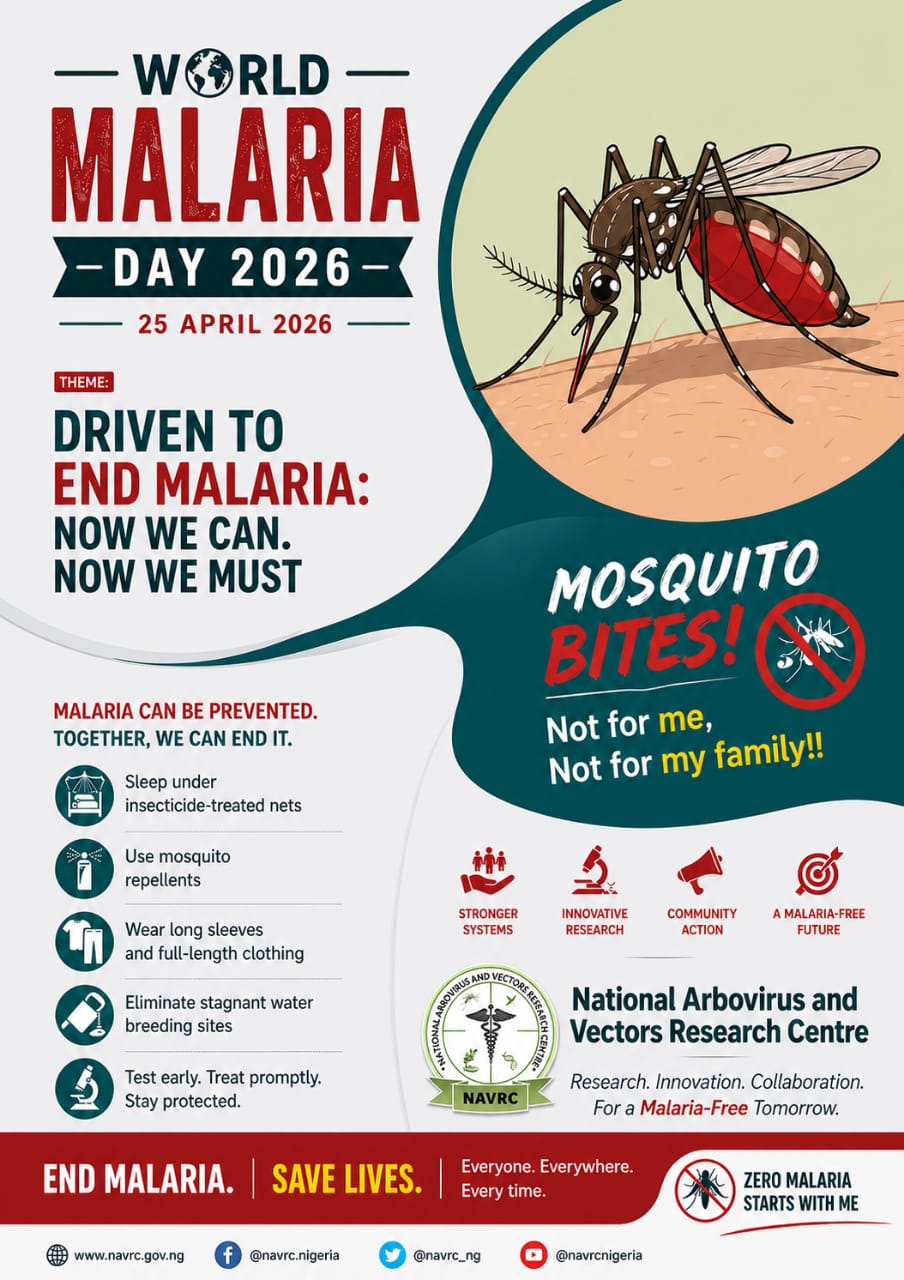
WORLD MALARIA DAY 2026: “Driven to End malaria: Now we can. Now we must”,
The battle to control malaria that began from time immemorial is gradually coming to an end, we are at the last lap of the control.
This slogan captures the shift from malaria control to malaria elimination. It argues that both the tools and the moral urgency exist today; therefore, “we can”. “Can” speaks to capacity on the ground; “must” speaks to the responsibility. Forty seven (47) countries have eliminated malaria since 2000. Cabo Verde and Algeria recently certified malaria-free.“Now we can.”The question that comes to one’s mind is, why do we think elimination is feasible today?
Scientific Breakthroughs: The “Now We Can” aspect highlights advancements such as new vaccines (being rolled out) and innovative mosquito control.Availability of better tools: Next-generation insecticide-treated bed nets (New-generation bed nets), making up 84% of new distributions, indoor residual sprays, and spatial repellents tackle insecticide-resistant mosquitoes.
New vaccines: RTS,S and R21 vaccines cut severe disease in children and are being rolled out at scale in 25 countries.Improved drugs: Artemisinin-based combinations + new drugs like tafenoquine for P. vivax radical cure.2. Data & technology: Digital surveillance, GIS mapping, and genetic tracking let us find and stamp out last cases faster.Proven success: 44 countries have eliminated malaria since 2000. Cabo Verde and Algeria recently certified malaria-free. Shows it’s possible.“Now we must” Why the urgency?According to the World Malaria Report 2025, progress is at risk:Biological challenges: Diagnostic failure: pfhrp2 gene deletions, which can make rapid diagnostic tests fail, are spreading and now reported in 46 endemic countries.Rising threats: Insecticide resistance: Resistance to pyrethroids (the main chemical on bed nets) is widespread, confirmed in 48 out of 53 reporting countries.
Drug resistance: Artemisinin partial resistance is confirmed in four African countries (Eritrea, Rwanda, Uganda, United Republic of Tanzania,) and spreading.
This is a critical danger to the main treatments for malaria.Invasive mosquitoes: Anopheles stephensi, an urban-dwelling, insecticide-resistant mosquito, is expanding its range in Africa, posing a new threat to cities. Climate change also expands the risk.Systemic challenges: A massive funding gap and Fragility of aid: Recent cuts in global health aid have disrupted health systems, surveillance, and campaigns, demonstrating how quickly progress can be undone.Plateau in progress: Global cases stalled at ∼249M since 2015. Without push, gains will reverse. Humanitarian & environmental challenges: Climate change, conflict, and humanitarian crises continue to drive malaria resurgence and disrupt essential services.
Equity issue: Malaria still kills a child every minute, mostly in poor, rural areas. Elimination is a justice issue.Window of opportunity: Current political will + Global Fund/PMI funding + new tools won’t last forever. Delay risks losing momentum.
The slogan is a call to action — we have the science, but elimination needs sustained funding, political commitment, and community ownership. _“Can”_ speaks to capacity; _“must”_ speaks to our responsibility. Therefore, this is a wake-up call for the governments and donors to invest in the “last mile” of malaria eradication.“Where there is will, there is a way.”